
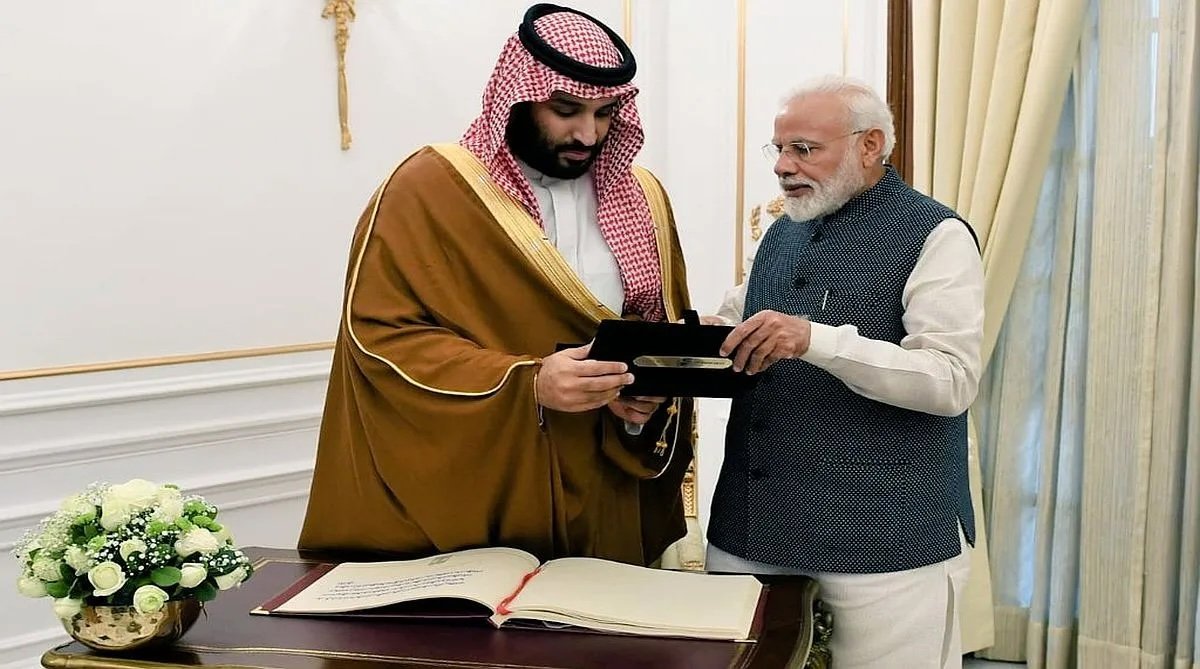
Prime Minister Narendra Modi is embarking on another pathbreaking visit to Saudi Arabia today (April 22, 2025). This marks his third visit to the Kingdom, the most by any Indian premier, and follows the 2023 visit of Saudi Crown Prince Mohammed bin Salman to India during its G20 Presidency. The trip aims to reinforce the strategic, economic, and cultural partnership between India and Saudi Arabia, building upon progress made during Modi’s previous visits in 2016 and 2019.
Modi’s visit takes place against a complex regional backdrop in West Asia, which is grappling with ongoing conflicts, such as those in Gaza and Yemen and the resurgence of extremist groups, posing regional and global security threats. The visit is significant not only for its timing—coming just weeks before U.S. President Donald Trump’s planned trip to the Kingdom—but also for the expectations within the region for India to play a more active role in promoting stability and securing vital maritime trade routes, including the Strait of Hormuz and Bab al-Mandeb.
Steered by PM Modi and Crown Prince Mohammed Bin Salman, whose personal rapport has been key, India-Saudi bilateral relations have significantly advanced over the past decade. Together, they have transformed the relationship from a traditional, transactional focus on energy and trade into a multi-faceted strategic partnership centred on economic ties, security, and defence cooperation.
Establishing the Strategic Partnership Council in 2019 formalised and deepened this cooperation across various sectors. Tangible outcomes include bilateral trade reaching $43 billion in 2023-24 and an upsurge in investments, with Indian investments in Saudi Arabia surpassing $3 billion, matching the Kingdom’s cumulative FDI in India.
Discussions during the forthcoming visit are expected to cover a broad spectrum, including regional stability, connectivity, energy and food security, trade, investment, and people-to-people contacts. Security and defence cooperation will remain a central pillar of these talks.
Bilateral defence collaboration exemplifies this transformation, evolving from limited engagement to a robust partnership featuring joint military exercises (‘Sada Tanseeq’, ‘Al Mohed Al Hindi’), high-level strategic dialogues, and growing defence industry collaboration. This shift is driven by converging security interests in the Gulf and Indian Ocean regions and Saudi Arabia’s Vision 2030 goal to localise defence procurement, leading to the exploration of joint defence technology development and production.
Security cooperation between the two countries has also intensified, with deepened intelligence sharing, coordinated efforts against terror financing and radicalisation, and enhanced collaboration on transnational crime. This partnership encompasses institutionalised dialogues, joint training, and work within multilateral forums to counter threats from groups like Al Qaeda and ISIS. Furthermore, Saudi authorities have actively monitored potential terrorist financing networks and supported India’s efforts to bring fugitives to justice.
Saudi Arabia remains crucial to India’s energy security, serving as its third-largest supplier and providing approximately 14.3% of India’s crude oil and 18.2% of its LPG imports. Building on this foundational energy relationship, discussions during the upcoming visit may include India seeking more favourable crude import terms, potentially addressing pricing or the ‘Asian Premium’ while emphasising the long-term value of the partnership.
Another potential agenda item is India’s standing invitation for Saudi Aramco to participate in Phase II of the Strategic Petroleum Reserves (SPR) program, involving new reserves with a capacity of 6.5 million metric tons (MMT). Despite several rounds of discussion, Saudi Arabia’s response has been cautiously positive but not definitive.
Efforts to revive the stalled West Coast Refinery project, for which the Kingdom had pledged a massive $50 billion investment, are also anticipated. Both countries have converged on a revised strategy to develop three smaller refineries, each with a capacity of 20 million metric tonnes per annum (mmtpa), instead of a single large refinery with a capacity of 60 mmtpa. While specific sites are still under consideration, potential regions include Gujarat and Andhra Pradesh, alongside a reconfigured plan for Maharashtra’s Ratnagiri area.
Beyond traditional energy, leaders are expected to advance collaboration in renewables, focusing on solar energy, green hydrogen, and green ammonia. This aligns with ambitious 2030 targets for both nations (India: 500 GW renewable capacity; Saudi Arabia: 50% energy from renewables). Talks will likely concentrate on joint research and development, pilot projects, and technology sharing to enhance green hydrogen production, storage, and export, potentially establishing India and Saudi Arabia as leaders in the global green hydrogen market by leveraging mutual strengths.
India and Saudi Arabia are focused on identifying specific projects to leverage Saudi Arabia’s plan to invest over $100 billion in India across multiple sectors. A joint task force under the Strategic Partnership Council provides a structured approach to facilitate this. Furthermore, the anticipated opening of an office by Saudi Arabia’s Public Investment Fund (PIF) in Gujarat’s GIFT City is expected to accelerate these investments significantly.
Advancing the India-Middle East-Europe Economic Corridor (IMEC), a major connectivity initiative positioning Saudi Arabia as a key hub linking India to Europe via the Middle East, is also expected to be a priority. Progress on IMEC varies: the Eastern Corridor section (linking India and the UAE) is moving forward more rapidly due to strong ties and existing infrastructure. However, the Western segment, particularly the rail link planned from the UAE to Israel via Saudi Arabia and Jordan, faces significant delays stemming from regional conflicts and instability.
PM Modi’s crucial visit to Saudi Arabia highlights India’s broader vision to act as a reliable regional power contributing to maritime security and regional stability, especially given current regional tensions involving Iran, Israel, and other Gulf countries. Amidst complex geopolitical shifts, India’s proactive engagement with Saudi Arabia represents a key step towards securing its energy needs, expanding its strategic influence, and fostering a resilient, multipolar regional order.
(Image Source: The Statesman)

Excellent insights Dr. Sayeed. Your depth and breadth of knowledge shows your vast experience and deep commitment to India-West Asia relationships.
Thanks for eloquently articulating your insights.
PM Modi’s visit to Saudi Arabia underscores India’s strategic foresight in strengthening ties amid regional volatility. It reflects a balanced approach to energy security, regional stability, and positioning India as a dependable partner in a multipolar world.
I enjoyed this article a lot—interesting, detailed, and very helpful.
The site is also easy to use and full of quality material.