
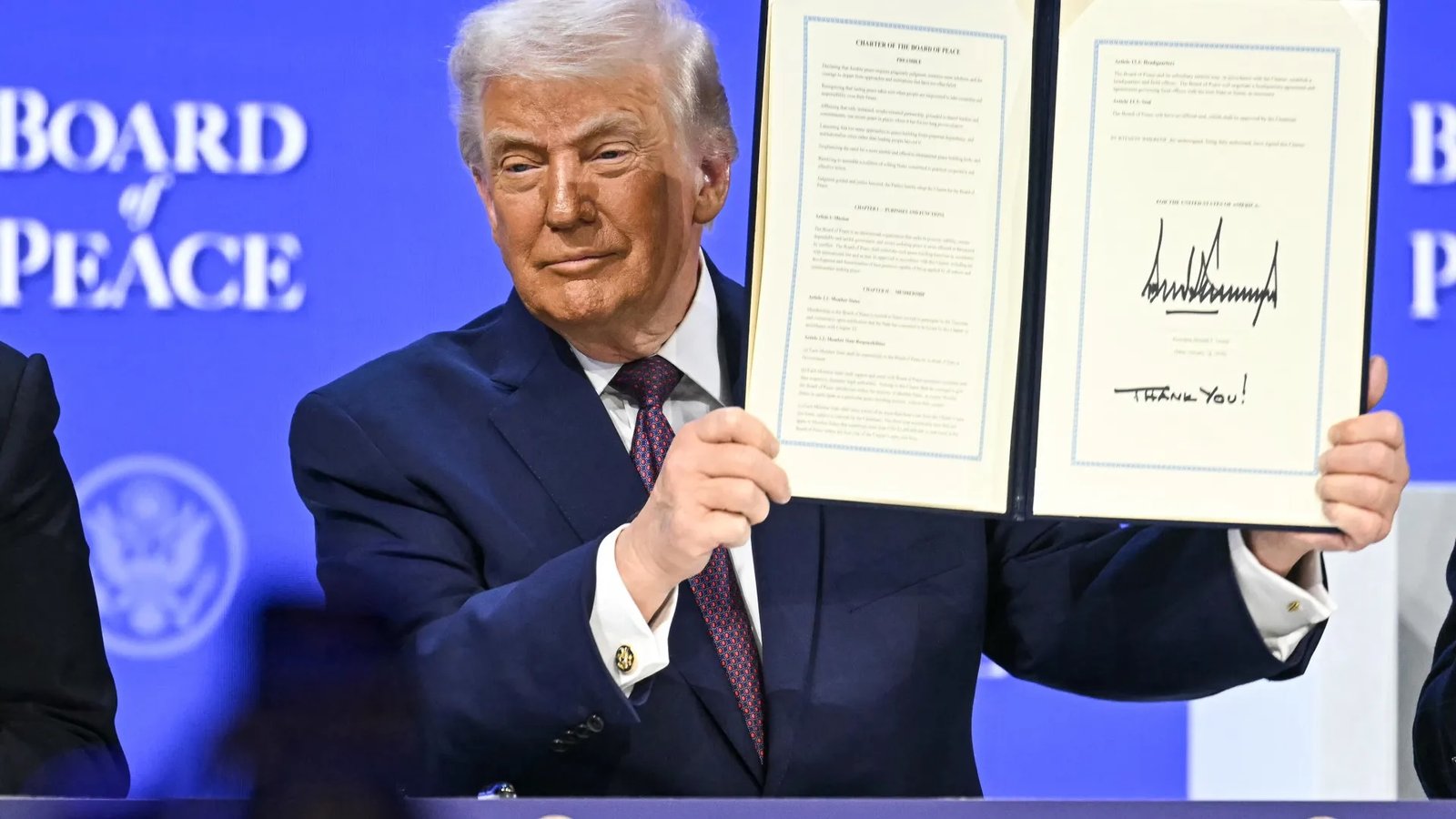
The formal inauguration of the Board of Peace at the World Economic Forum in Davos this week marks a profound inflexion point in global governance. Though politically endorsed through UN Security Council Resolution 2803, the Board represents a decisive departure from the consensus-driven multilateralism of the post-1945 order toward a transactional, executive-centric model of conflict management. For India, the invitation to join this body as a founding participant arrives at a moment of strategic strain, compelling New Delhi to navigate an increasingly narrow corridor between its doctrine of strategic autonomy and the pragmatic necessity of stabilising a brittle relationship with Washington.
At Davos, President Donald Trump unveiled the Board’s Charter and assumed the role of inaugural Chairman—a position endowed with sweeping and largely unchecked authority. The Board possesses international legal personality yet operates outside the UN’s formal command structure, with its Chairman empowered to determine membership, dissolve the body, veto decisions, and define missions. Most controversial is the Charter’s explicit monetisation of influence: states contributing more than US$1 billion within the first year are exempted from term limits, effectively securing permanent membership and sustained voting power, while non-paying members are restricted to renewable three-year terms at the discretion of the Chairman.
This concentration of authority in a single executive figure, combined with the corporatist logic of a “pay-to-play” architecture, introduces a graded system of privilege in which sovereignty shifts from an equal right to a weighted hierarchy. That this structure was formally endorsed at Davos—despite visible discomfort among several European delegations—signals the growing acceptance of power-weighted multilateralism in an era where institutional design increasingly mirrors market mechanisms.
The geopolitical context in which India must evaluate this invitation is harsh. The aftereffects of the April 2025 Pahalgam terrorist attack, which led to India’s military response in the form of ‘Operation Sindoor’ on May 7, 2025, targeting militants across the Line of Control. Although hostilities ended quickly with a bilateral ceasefire on May 10, 2025, the diplomatic narrative did not. President Trump’s repeated public claims that he personally mediated the ceasefire were seen in New Delhi as a direct challenge to India’s firm rejection of third-party mediation, especially regarding Kashmir. What started as rhetorical overreach soon had tangible consequences.
In August 2025, Washington imposed a steep tariff regime—up to 50 per cent—on selected Indian exports, officially citing India’s continued procurement of discounted Russian energy. In New Delhi, the move was widely read as coercive signalling, reinforcing the Trump administration’s view that trade, security, and political alignment are interchangeable instruments. Against this backdrop, the invitation to join the Board of Peace functions less as a benign multilateral overture and more as a calibrated strategic test.
The dilemma for India is geometric in its compression. Should India refuse outright to participate, it risks vacating strategic space and allowing Islamabad unchallenged access to a US-led forum that claims both political and financial leverage. Pakistan has been invited to the Board and has publicly welcomed the initiative, viewing it as a platform to strengthen its diplomatic engagement with Washington. New Delhi’s absence from such a body could invite further economic retaliation from an administration that demonstrably rewards compliance and penalises dissent.
Conversely, full participation—particularly through the US$1 billion contribution required for permanent membership—would impose severe costs. Endorsing a monetised governance model would undermine India’s long-cultivated identity as a champion of the Global South and an advocate of equitable multilateralism. Domestically, such a payment would be politically indefensible, easily portrayed as tribute to an unpredictable foreign leader rather than an investment in peace. Strategically, it would entangle India in a governance structure whose legitimacy remains contested and whose longevity depends on the will of a single individual.
The best way forward is what can be called calibrated peripheral engagement. India should agree to participate as a temporary member while clearly refusing permanent, fee-based status. This approach preserves situational awareness, prevents Pakistan from monopolising the narrative, and maintains diplomatic access to Washington—without legitimising the Board’s most problematic structural features. Crucially, it enables India to influence outcomes from within while retaining the option to disengage if the institution drifts further from international legal norms.
India’s contribution should be precisely defined. New Delhi ought to explicitly reject large cash transfers and instead emphasise in-kind, civilian-focused support aligned with its established development diplomacy. Assistance in public health, pharmaceutical supply chains, digital governance platforms, and institutional capacity-building for Gaza’s civil administration would be both credible and politically justifiable. Such engagement would bolster India’s humanitarian reputation and its long-standing support for Palestinian welfare, without endorsing what critics increasingly call the Board’s “venture-capital approach” to post-conflict reconstruction.
Equally vital is establishing a clear red line on military participation. The Charter-mandated International Stabilisation Force is technically authorised by UNSC Resolution 2803 under Chapter VII, yet it operates outside the traditional UN command structure and lacks a robust accountability mechanism. Any deployment under such conditions would expose Indian forces to legal, political, and reputational risks, especially in the Arab world. Upholding India’s long-standing stance—that troops are deployed abroad only under explicit UN command within established peacekeeping frameworks—remains crucial to maintaining its normative consistency and regional standing.
Finally, India should leverage its influence to quietly coordinate with other Global South members—such as Egypt, Indonesia, and Brazil—to temper the Board’s most unilateral tendencies. A loose consultative caucus can advocate for political rights, civilian protection, and a re-centring of the UN, ensuring the Board does not become a permanent substitute for multilateral legitimacy. This coordination would showcase India’s ongoing commitment to solidarity with the Global South while strategically guarding against institutional capture by executive prerogative.
