
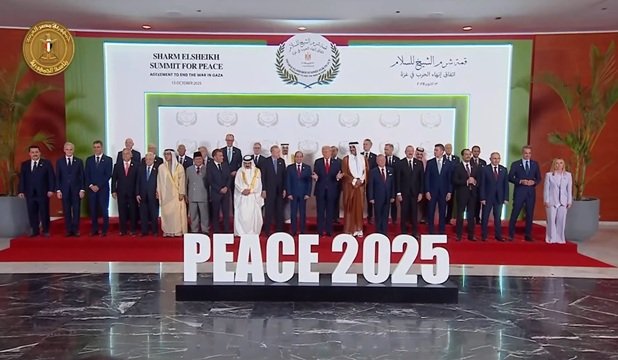
The Sharm el-Sheikh Summit of October 2025 exemplifies high-stakes, personality-driven diplomacy. It successfully ended a devastating two-year conflict between Israel and Hamas, securing a ceasefire and the return of hostages, providing momentous human relief. However, the summit is more a tactical achievement in crisis management than a strategic step toward peace. Its structure reveals a central paradox: it achieved immediate, tangible results by intentionally postponing the main political issues of sovereignty, occupation, and mutual recognition that drive the conflict. As a result, the summit institutionalised a fragile, externally managed status quo that remains highly vulnerable to collapse.
The diplomatic groundwork was meticulously laid during U.S. President Donald Trump’s preceding visit to Israel. This was a calculated prelude designed to manufacture consent and build an irreversible narrative of success before the summit convened. His address to the Israeli Knesset was a carefully calibrated act of political theatre. By declaring “the war is over” and repeatedly telling lawmakers, “You’ve won,” Trump framed the deal as an Israeli victory. This provided essential political cover for Prime Minister Benjamin Netanyahu, whose far-right coalition partners opposed ending the war without the complete eradication of Hamas.
The Israeli public, exhausted by the conflict and desperate for the return of the final 20 living hostages, reacted with euphoria directed almost entirely at Trump. This dynamic effectively neutralised Netanyahu’s domestic opposition by creating a more powerful, external source of political legitimacy. The deal’s foundation was thus built not on a shared vision between Israelis and Palestinians, but on a power transaction between a U.S. president and an Israeli prime minister—an inherently unstable arrangement.
The summit itself produced a series of concrete achievements. Its foremost success was the multilateral endorsement of a framework that initiated the release of the Israeli hostages in exchange for approximately 2,000 Palestinian prisoners. For families on both sides, this was a moment of profound relief. The agreement also facilitated a desperately needed surge in humanitarian aid into Gaza, where famine-like conditions had taken hold. Symbolically, the presence of over 20 world leaders conferred a powerful sense of international consensus and collective responsibility. This public diplomacy converted a fragile, U.S.-brokered arrangement into a global commitment, raising the political cost for any party that violated its terms.
India’s participation exemplified a more calibrated approach. New Delhi dispatched a junior minister as its special envoy, a move of strategic restraint designed to avoid diplomatic entanglements, particularly with Pakistan’s prime minister also in attendance, and to sidestep President Trump’s persistent claims of mediation. While Prime Minister Narendra Modi abstained from attending personally, he was vocally supportive on social media, praising the ceasefire and the efforts of Trump and Netanyahu. This balancing act—maintaining robust ties with Israel and the US while reiterating support for dialogue and humanitarian relief underscores India’s cautious, multi-aligned foreign policy in a volatile region.
Despite the broad international presence, the agreement is built on a foundation riddled with structural flaws. The most critical flaw was the absence of Israel and Hamas as formal signatories. Netanyahu cited a religious holiday for his non-attendance, while Hamas, which had dismissed parts of the plan, was not invited. This glaring omission transforms the agreement from a binding treaty into a non-binding political compact, its enforcement relying entirely on the sustained pressure of external mediators.
Furthermore, the agreement is marked by a dangerous lack of transparency and deliberate ambiguity. Key terms central to the deal’s later phases, such as the scope of Hamas’s “demilitarisation” and the sequencing of Israel’s “withdrawal”, were left vague, creating significant room for future conflict over interpretation. The summit also failed to define a legitimate and viable transitional authority for Gaza, gesturing toward a “technocratic, apolitical Palestinian committee” without specifying its composition or selection process. This creates a power vacuum that invites a protracted struggle for control.
Perhaps most damningly, the summit deliberately sidestepped any credible pathway to a two-state solution. While paying lip service to Palestinian aspirations, the plan offered no timeline for sovereignty, no mention of ending Israeli occupation of the West Bank, and no mechanism to address Israeli settlements. This exclusive focus on managing the crisis in Gaza while ignoring the root causes of the broader conflict reveals a strategy of conflict management over conflict resolution. It treats the Israeli-Palestinian conflict as a chronic condition to be managed with periodic interventions, rather than an acute problem to be solved.
Looking ahead, the trajectory is highly uncertain. The short-term forecast is for a tense and contested implementation. The ceasefire will likely hold in major urban centres but will be punctuated by localised clashes. The primary source of conflict will be the formation of the interim governing authority, with intense friction expected between Hamas remnants, Palestinian Authority appointees, and international overseers.
In the long term, three divergent futures are possible. The optimistic scenario involves the interim authority gaining legitimacy, leading to elections, accelerated reconstruction, and renewed final-status negotiations. This remains the least likely outcome. A more probable scenario is a frozen conflict: the ceasefire largely holds, but reconstruction stagnates, and core political issues remain unresolved, entrenching the occupation under the guise of a permanent “transitional” phase. The pessimistic scenario sees the agreement collapse following a major violation, prompting a massive Israeli military response and a return to high-intensity warfare.
The Sharm el-Sheikh Summit can be seen as a diplomatic paradox. It was a resounding success in achieving its immediate, narrow objectives: it stopped the killing, brought hostages home, and opened Gaza to a life-saving flow of aid. Yet, by sidestepping the foundational issues of Palestinian statehood and the end of Israeli occupation, it failed to initiate a genuine peace process. The summit provided an immense and welcome reprieve from horrific violence, but in substituting external management for internal resolution, it has likely locked the region into a frozen conflict. It has paused the violence but has not altered the fundamental trajectory of the conflict. A peace that deprives one side of substantive autonomy or a credible political horizon constitutes merely a more enduring form of domination, destined to collapse beneath the burden of its inherent contradictions.

Excellent article Ambassador Ausaf.
“Manufactured consent” sums it up. It will not last for long as the other party was not a party.
Excellent article
👏 Aptly written & you have touched all the aspects of this “Iceberg” of a so called “Peace” fiasco…which though taken a little positive has some promising HOPE of a tiny step towards the path to – “miles to go”🤲😔