
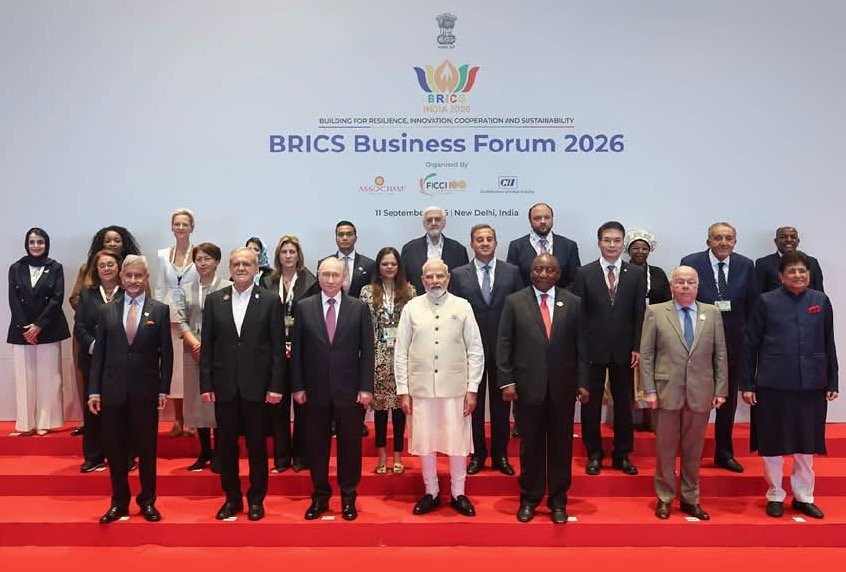
When the leaders of an eleven-nation bloc representing roughly half of humanity gathered at Bharat Mandapam on 12–13 September, the question was whether BRICS could still agree. In May, its foreign ministers had failed to issue a joint statement over differences on West Asia. India, chairing the grouping for the first time since its post-2024 expansion, responded in 140 paragraphs. The New Delhi Declaration, adopted by consensus, was longer and more pointed than many had expected — and its passage, after intense negotiations, was the chairship’s central diplomatic achievement.
For India, the declaration reads like a scorecard with more credits than debits. Its clearest gain is on terrorism: the text condemns “in the strongest terms” the 22 April 2025 attack in Jammu and Kashmir that killed twenty-six people, and adopts New Delhi’s preferred language on cross-border movement, terror financing, safe havens, rejection of “double standards,” and the long-stalled Comprehensive Convention on International Terrorism. That a dated, specific reference survived in a document China co-signed is no small feat. India also stamped the outcome with its initiatives — an artificial-intelligence governance statement, digital public infrastructure, a mental-health centre of excellence, and the International Big Cats Alliance — during a chairship that convened more than four hundred meetings across thirty Indian cities. On Sunday, PM Modi announced agreement on an integrated infectious-disease early-warning system—an idea BRICS has discussed for years. Its implementation will test whether the bloc can deliver.
From the bloc’s vantage, the declaration is a manifesto of the aggrieved Global South. It calls for a restructured Security Council, realigned IMF quotas, a revived WTO appellate function, and a fairer development-finance architecture anchored by the New Development Bank. It condemns “unilateral” tariffs and secondary sanctions and — in its sharpest passage — protectionism “under the guise of environmental objectives,” a thinly veiled rebuke of Europe’s carbon border tax. On West Asia, it names Israel in its Lebanon passage, notes the International Court of Justice case, and urges restraint in strikes on Iran’s nuclear facilities. Taken together, these positions show BRICS seeking a greater say in how global institutions set the rules.
Beneath the rhetoric lay a quieter agenda of institution-building. The bloc kept work on a grain exchange alive, studied cross-border payment interoperability in national currencies, and welcomed the New Development Bank into a second decade of local-currency lending. None of this amounts to a rival financial system, but together it sketches the scaffolding of one — incremental, voluntary and consensus-bound, in the manner the grouping prefers. For India, the value of these modest steps will depend less on announcements than on whether trade, payments and lending become easier in practice.
Yet the shortcomings are as instructive as the wins. The Security Council paragraph rolls over settled language: China and Russia “support the aspirations” of Brazil and India for a “greater role,” carefully short of endorsing permanent seats. There is no move towards a common BRICS currency, only cautious talk of local-currency settlement. There is no standalone paragraph on Ukraine — a silence that betrays the bloc’s inability to speak collectively about a war involving one of its own. Much of the economic section is a lattice of working groups and portals rather than binding commitments, and China’s dominance in intra-bloc trade sits uneasily alongside the language of solidarity.
India’s position embodies the tension. As host, it accepted planks — Iran’s WTO accession, the anti-sanctions clause, and criticism of Israel — that run ahead of its bilateral instincts, the price of consensus. This is multi-alignment in practice: bank your own wins, absorb others’, and avoid an open breach with Washington, Brussels, or Tel Aviv.
If the declaration was the summit’s text, the sidelines were its subtext, and India’s convening power was on display. The Modi–Putin meeting reaffirmed a deepening partnership — with a $100 billion trade target by 2030, defence and energy cooperation, and a gift of the Tamil classic Thirukkural, rendered in Russian — even as India works to narrow a lopsided trade deficit. The Modi–Xi encounter was managed atmospherics rather than a breakthrough: Modi held that “peace and tranquillity in the border areas” remains the precondition for normal ties and pressed on the trade imbalance, while Xi invoked the “important responsibilities” of the world’s two most populous nations. With Iran’s President Pezeshkian, Modi framed the relationship as a “long-term, win-win strategy,” stressing freedom of navigation and the safety of Indian seafarers.
The most quietly consequential meeting had no Indian at the table. Pezeshkian and Abu Dhabi’s Crown Prince Sheikh Khaled bin Mohamed bin Zayed Al Nahyan — representatives of two states whose differences had threatened consensus — met on the margins to discuss “de-escalation and stability in the region.” That was a diplomatic dividend of the venue India provided. New Delhi, able to keep open channels with Tehran, Abu Dhabi, Moscow, Washington and Tel Aviv simultaneously, turned its chairmanship into a platform for dialogue among rivals.
What, then, is the verdict? The declaration made BRICS louder and more assertive, a bid to reform the institutions of the old order from within rather than overthrow them. But size brought constraints: on the hardest questions of power and war, the bloc could agree only to be vague. For India, the summit burnished its standing as a convenor of the Global South and as a bridge between camps that no longer talk easily to one another. The achievement was real; so were its limits. In an age of fragmentation, bringing eleven fractious states to a joint declaration — and two rivals to the same table — may be the more durable accomplishment.
