
Trump’s endorsement changes what the Makkah agreement means. For India, the corridor matters more than the clause.
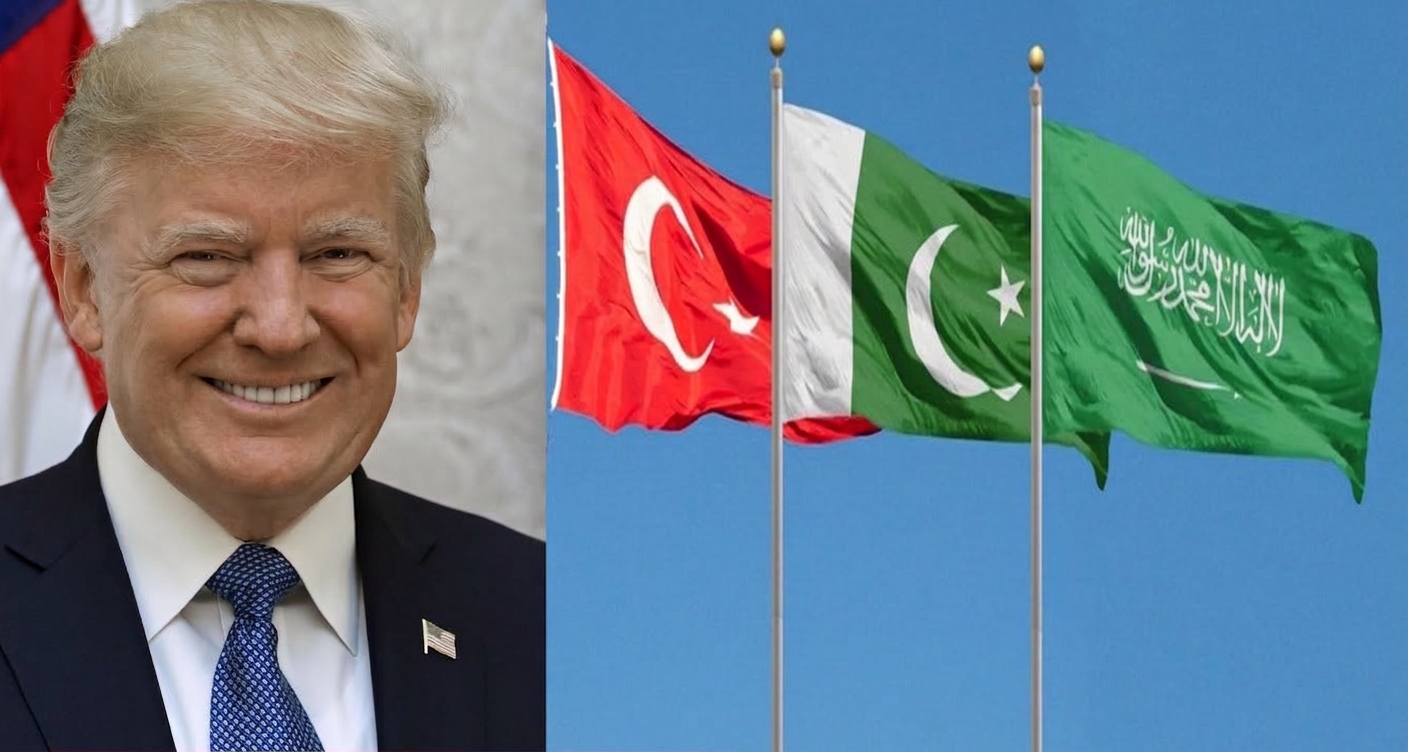
The most revealing comment on the Makkah Joint Defence Agreement since its signing came not from Riyadh, Ankara or Islamabad, but from Washington. On Sunday, Donald Trump wrote on Truth Social that the pact showed the Middle East coming together and that its members would at last be able to defend themselves more meaningfully, calling it a “BIG, BOLD, IMPORTANT FIRST STEP”. An American president applauded a mutual defence pact among three US partners, concluded without American participation, and did so without reservation.
That endorsement should discipline the interpretations now circulating. A pact widely read as evidence of Gulf disillusionment with Washington has instead been welcomed by Washington. Washington has spent two decades asking its regional partners to shoulder more of their own defence, and an arrangement pooling Saudi money, Turkish industry and Pakistani manpower against security burdens Washington might otherwise be expected to carry is precisely the burden-sharing it has demanded.
The signatories have carefully framed it in those terms. On 13 August, Turkey’s defence ministry, outlining the mechanisms, described the agreement as defensive, stated that it designates no country as a common enemy, and said it was ‘not considered an alternative or rival to NATO’, but rather a complement to the existing security architecture. The mechanisms are substantial without amounting to an integrated military structure: standing coordination among defence and foreign ministers and chiefs of staff; joint exercises across land, naval, air, and unmanned systems; and defence-industrial cooperation, supported by a permanent secretariat in Saudi Arabia.
Ankara’s broader conduct sharpens the point. In the same week that he urged Egypt to join the pact, President Erdoğan publicly said he has a promise from Trump on the F-35 and is waiting for it to be honoured. Ankara’s simultaneous pursuit of renewed F-35 access suggests diversification and repricing within the American security system, not strategic divorce from it.
The strongest case against this reading holds that the pact proves the American-led order built since the 1970s has simply ended, and that the region is dividing into two blocs, one committed to the Abraham Accords and another gathering around Makkah. The argument deserves serious attention because the erosion it describes is real and well documented, with Washington’s non-response to the 2019 strikes on Saudi oil facilities among its clearest manifestations.
Yet the evidence complicates the picture. Forty-eight hours after the signing, the Houthis struck the Aramco refinery at Jizan, and Riyadh did not call on its new partners. The episode demonstrates how much political discretion still separates the pact’s collective-defence language from its military activation. The Saudi-Pakistan agreement has been in force since September 2025, and during five months of Iranian missile fire, Pakistan deployed troops, aircraft and air defences without entering the war. The GCC’s own Joint Defence Agreement of 2000 carries a comparable obligation, yet even its formal activation after the 2025 attack on Qatar produced no conventional collective military response.
Egypt is now the test worth watching. Ankara has pressed Cairo publicly and privately, but Foreign Minister Badr Abdelatty has replied that binding military commitments require careful examination in light of Egypt’s constitution and its existing obligations, including its arrangements in the eastern Mediterranean. Saudi-sourced reporting suggests Riyadh itself was reluctant to include Egypt, partly because of Cairo’s closeness to Abu Dhabi. An alliance whose first proposed expansion divides its founders is not yet a bloc.
For India, this shifts the focus away from the collective-defence clause, which was never India’s principal vulnerability. Given Saudi stakes in India across energy and investment, and a community of roughly 2.75 million Indians in the Kingdom, it is implausible that Riyadh would act against New Delhi on Islamabad’s behalf. The more consequential development lies elsewhere: a proposal by Riyadh and Ankara to redirect the rail component of the India-Middle East-Europe Economic Corridor (IMEC), so that goods would move from Saudi Arabia through Jordan and Syria to Turkey, bypassing Israel altogether.
If that idea gains traction, the corridor India signed on to in 2023 would take on a different geography and a different set of gatekeepers, including Türkiye, which has consistently backed Pakistan on Kashmir and was not part of the original design. For India, the corridor’s changing geography may matter far more than the pact’s Article 5-style guarantee.
That does not leave India without options. The founding meeting of the Multinational Maritime Defence Coalition in Riyadh on 30 July drew representatives from 43 of 51 invited governments, though only 14 initially endorsed the coalition. India was not among them, but neither were the United Arab Emirates, Oman or the United States. India already has considerable experience escorting merchant shipping through these waters. New Delhi should deepen and regularise its strategic dialogues with Riyadh and Abu Dhabi, press its case on IMEC’s routing while the question remains open, and strengthen the port, storage and supply-chain infrastructure that has proved its value during this year’s disruptions.
Erdoğan has said that regional problems should be settled by regional actors and that the pact is a first step towards that. He may be right about the direction of travel. But an order in which Washington applauds, Ankara awaits its aircraft, and Riyadh has yet to invoke its own guarantee is not a new world taking shape so much as an old one being renegotiated. For India, the strategic significance of Makkah may ultimately lie less in whether Riyadh would fight for Pakistan than in how the emerging Saudi-Turkish alignment reshapes the economic and connectivity architecture to India’s west.
