
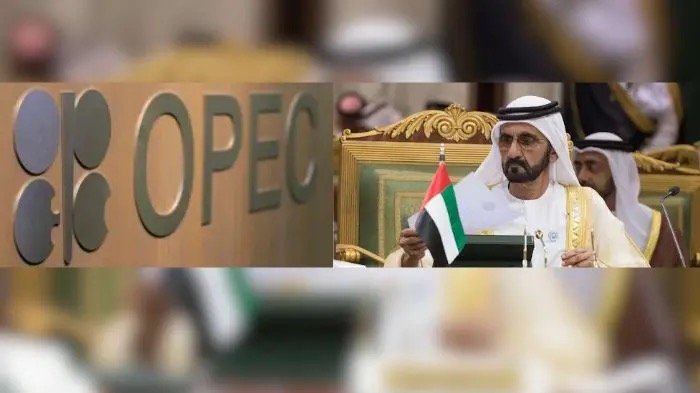
When the United Arab Emirates announced on 28 April that it was walking out of OPEC and OPEC+ after fifty-nine years, the news was framed in most Western capitals as a story about Saudi Arabia’s loss and Donald Trump’s gain. It is both. But for New Delhi, which imports roughly 85 per cent of its crude, the more consequential question is whether the cartel that has set the price ceiling on Indian growth for half a century has finally begun to crack — and what India should do with the opening.
The immediate facts argue for caution. The UAE is leaving OPEC in the middle of a war. Since late February, the US-Israeli campaign against Iran has effectively closed the Strait of Hormuz, the chokepoint through which a fifth of the world’s seaborne oil normally moves. Brent has touched $119.50 a barrel since the conflict began and was trading around $111 on the day of the announcement. UAE’s production itself has reportedly fallen 40 per cent from its February level because tankers cannot leave ports. Energy Minister Suhail al-Mazrouei said that the moment was chosen precisely because “the market is undersupplied” and the exit “is not going to hugely impact the market.” For Indian refiners and consumers, the war will determine petrol prices this summer, not the UAE’s exit from OPEC.
The structural story, however, runs the other way — and it runs in India’s favour. The UAE has invested heavily to expand ADNOC’s nameplate capacity to 4.85 million barrels a day, with a publicly stated target of 5 million by 2027. Its OPEC+ quota has been holding it at roughly 3-3.5 million. The gap between what Abu Dhabi can produce and what it has been allowed to sell is, in revenue terms, the price the UAE has been paying to keep Saudi Arabia’s price-defence strategy intact. With Hormuz open and quotas gone, that capacity will hit the market. Capital Economics’ David Oxley put it precisely: the announcement “does suggest that global supplies will be higher than would otherwise be the case once the Strait of Hormuz reopens.” Rystad Energy’s Jorge Leon, formerly of the OPEC secretariat, was blunter — outside the group, the UAE has “both the incentive and the ability to increase production.” The market loses, in his words, “one of the few shock absorbers it had left.”
For an importer, fewer shock absorbers are uncomfortable in the short run and welcome over the cycle. Volatility will rise; the floor under prices will fall. India’s experience after 2014, when US shale broke OPEC’s pricing power for the first time, and Brent collapsed from $115 to below $30, is the relevant template. The cartel’s discipline cracked once before; the conditions for it to crack again are now in place. India was the structural beneficiary the first time around, and the arithmetic has not moved: every $10 fall in the oil price improves the current account by close to $15 billion and shaves perhaps 50 basis points off headline inflation. A fragmenting OPEC, plus a UAE pumping flat-out, is precisely the configuration in which those gains return.
The bilateral overlay sharpens the opportunity. India and the UAE already operate one of the closest commercial relationships in the Gulf, anchored by the 2022 CEPA, sustained ADNOC participation in India’s strategic petroleum reserves, and a high-level political relationship that has held steady through two years of acute regional turbulence, from Gaza to the Houthi Red Sea campaign to the present war on Iran.
An Abu Dhabi unshackled from OPEC quotas, looking to monetise reserves before the energy transition compresses long-term demand, has every reason to deepen direct, term-contract supply relationships with its third-largest trading partner — and India has every reason to take the offer. There is a dirham-rupee invoicing track record to build on, refining and petrochemical investment commitments to operationalise, and a strategic petroleum reserve that remains under-built relative to the country’s exposure.
There are three risks New Delhi should hedge against. The first is that a Saudi response — either a price war to discipline Abu Dhabi or, less plausibly, deeper output cuts — produces volatility severe enough to overwhelm any structural benefit. The 2020 Saudi-UAE clash that briefly drove Brent below zero is the cautionary precedent. The second is that the same Iran war that made the exit possible also keeps Hormuz unsafe long enough to nullify the supply gains India is hoping for; UAE crude reaching India still has to transit the same chokepoint, and the Fujairah pipeline that bypasses the strait has limited spare capacity. The third, more diffuse risk is geopolitical: a UAE drawing closer to the US-Israel axis, openly critical of GCC and Arab League passivity in the war, will be a less neutral partner than the one India has been used to. New Delhi’s careful balance among Riyadh, Abu Dhabi, and Tehran will require more, not less, diplomatic attention.
None of this changes the basic arithmetic. OPEC’s share of the internationally traded oil market is now closer to 50 per cent than the 85 per cent it commanded in the 1970s; the cartel may currently have leverage, but it does not have a monopoly. The UAE’s departure further reduces that leverage. For the world’s third-largest oil consumer, that is a strategic windfall — but only if it is treated as one. The right Indian response is not satisfaction at the discomfiture of OPEC, but a quiet acceleration: longer-dated UAE supply contracts, faster reserve build-out, deeper rupee-dirham settlement, and a refining strategy positioned for a world in which the price of crude is set, more often than not, by competition rather than by quota.
Cartels rarely collapse from outside pressure. They unravel when their most capable members decide that loyalty costs more than independence — a calculation that has now been made in Abu Dhabi. India’s task is to ensure that the next phase of the oil age, however long it lasts, is bought on better terms than the one the UAE has just walked out of.
