
The Middle East has become a testing ground for a new multipolar world, one where no single power dominates, but none can enforce rules either. As the United States recalibrates, China advances quietly, and regional actors pursue multi-alignment, the result is not equilibrium but instability. Does this emerging multipolarity promise balance, or merely redistribute instability across new fault lines?
The Middle East has entered an era of organised anarchy. The old architecture of American primacy, UN-mediated conflict resolution, and rule-bound diplomacy has been consciously repudiated by the very powers that built it and the very actors it was meant to contain.
What is emerging is not a new order with settled rules and recognised hierarchies, but a competitive interregnum in which military coercion, economic weaponisation, and strategic ambiguity have replaced the grammar of international law. The collapse of the Assad regime in Syria in late 2024, the Israel-Iran Twelve-Day War of June 2025, the unrelenting catastrophe in Gaza, and the fracturing of Gulf alignments are not discrete crises but symptoms of a single structural breakdown.
The 2026 Munich Security Conference captured this moment with unusual candour, bearing the theme “Under Destruction”—a confession from the custodians of the liberal order themselves that the post-World War II architecture is collapsing under the weight of great-power competition, regional realignment, and the weaponisation of economics.
For decades, the United States underwrote Gulf security, contained Iran, managed Arab-Israeli tensions through selectively applied pressure, and used multilateral institutions to legitimate its preferred outcomes. The Trump administration’s return to office formalised what had been gathering for years: Washington now openly pursues a sphere-of-influence logic, treating multilateral institutions as arenas of hostile lawfare rather than forums for legitimate governance. The EU’s foreign policy chief, speaking in early 2026, described the new paradigm as one characterised by “competition and coercive power politics.” The consequences have landed most heavily on the Middle East. Israel’s military supremacy—demonstrated in its suppression of Russian-supplied Iranian air defences—has been cemented as the primary instrument of US power projection. The region is no longer governed by a rules-based order; it is governed by outcomes on the battlefield.
A Four-Power Contest
Into this vacuum, four distinct actors advance competing visions of regional order.
The United States operates on the logic of coercive dominance, backing Israel unconditionally and using economic coercion to enforce compliance. Yet the Gaza war, prosecuted with American weapons and diplomatic cover, has destroyed the US standing across the Global South.
China pursues strategic patience. Its landmark brokering of Saudi-Iran normalisation in March 2023 demonstrated that Beijing can deliver diplomatic outcomes where Washington is too partisan to mediate. China makes no demands on governance; it offers infrastructure, investment, and political neutrality—a steady, long-game expansion requiring no military presence.
Russia, weakened by the Ukraine war and its strategic setbacks in Syria and Iran, nevertheless continues to play a stubborn spoiler’s game. Its bases in Libya, its Red Sea military foothold in Sudan, and its leverage with OPEC+ ensure its ongoing relevance even as its hard-power credibility has diminished. Moscow’s value lies less in what it can deliver and more in what it can complicate.
The most significant development, however, is the rise of regional middle powers as autonomous agents. Turkey, Qatar, and, above all, Saudi Arabia are no longer content to be objects of great-power management. They are positioning themselves as agents of history—pursuing multi-alignment, cultivating strategic ambiguity, and leveraging their geographic and economic centrality to extract concessions from all sides.
The Saudi Pivot and Palestine
Saudi Arabia’s transformation from a passive American client to a deliberate regional architect is perhaps the defining story of the new Middle East. Driven by Vision 2030, Riyadh has concluded that stability, investment, and legitimacy are better achieved through diplomacy than confrontation. The Kingdom normalised relations with Iran—ties now strained by the US-Israeli war against Tehran—signed a defence pact with Pakistan, co-chaired a Palestine conference with France, hosted Ukraine-Russia prisoner exchanges, and pragmatically opened its military bases to the United States while pledging massive investment in the American economy—all markers of a coherent, if evolving, strategy of structured ambiguity.
Yet Riyadh embodies the central contradiction of the emerging order. It still depends on the US security umbrella as its ultimate guarantee. It reaffirms Palestinian statehood in every forum while taking no structural steps to restrict Israel’s expansion. Saudi Arabia is, simultaneously, both the architect of a new regional order and its most eloquent illustration of constraint.
No single issue more starkly exposes the character of the emerging order than Palestine. The Arab League, the Organisation of Islamic Cooperation (OIC), and the broader Global South have collectively reaffirmed Palestinian statehood with remarkable consistency—at the Arab-Islamic Emergency Summit at Doha last September, at the Saudi-France co-chaired UN conference later that month, and at repeated UNGA sessions. Yet the structural balance of power remains unchanged: Israel continues to expand settlements and prosecute its Gaza campaign while facing no material costs from those who profess solidarity. Palestine functions as a litmus test in international politics: it reveals whether emerging multipolarity represents genuine democratisation of global governance, or merely a reshuffled hierarchy in which impunity for the powerful remains intact. So far, the evidence points toward the latter.
India’s Calculated Positioning
India’s engagement with this transformed Middle East reflects the doctrine articulated by its External Affairs Minister, S. Jaishankar, as “derisking in an age of uncertainty”. Speaking in February 2026, Jaishankar identified six structural features of the new international environment—US re-industrialisation, China’s export dominance, intensifying technology competition, redefined energy flows, military risk-taking, and contentious migration—and argued that India’s response must be diversification across every domain.
India’s Middle East strategy embodies this logic. The India-Middle East-Europe Economic Corridor (IMEC) is the most visible expression of India’s ambition to anchor an alternative connectivity architecture to China’s Belt and Road. The New Delhi Declaration of January 2026, adopted with the Arab League, formalised a relationship already worth over $240 billion in trade across five domains: economy, energy, education, media, and culture. India simultaneously deepened defence cooperation with Israel through a November 2025 MoU, while explicitly backing the Arab Peace Initiative of 2002—a position no Western power committed to binary alliance politics could sustain.
Yet India’s positioning has faced criticism. Its repeated abstentions on UNGA resolutions condemning the Gaza war—including a June 2025 resolution on the use of starvation as a weapon—have drawn sharp censure from Arab commentators and the public, which has highlighted the tension between India’s deepening strategic embrace of Israel and its aspirations in the Arab world. Jaishankar’s derisking framework, for all its intellectual elegance, is fundamentally geoeconomic; it lacks a moral vocabulary to address a world returning to the logic of power. If the new order demands not just strategic agility but principled credibility, India’s “constructive opportunism” may carry costs that compound over time.
A New Order or Organised Anarchy?
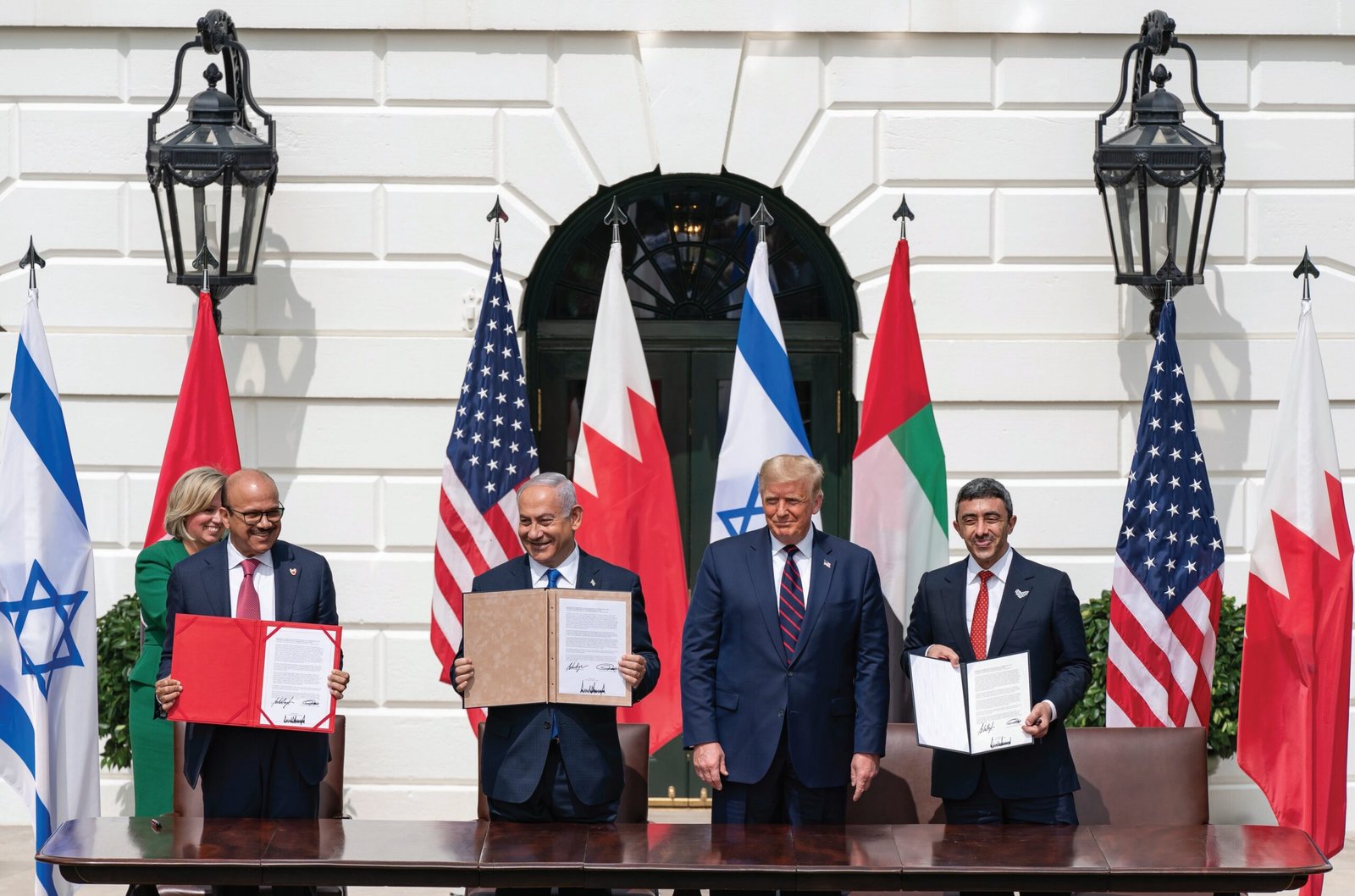
What is emerging in the Middle East is not, strictly speaking, a new order. It is, as noted, a competitive interregnum in which the old architecture has collapsed, but no replacement commanding broad legitimacy has been constructed. The UN Security Council is paralysed. Bretton Woods institutions remain skewed. No new multilateral framework equivalent to the post-1945 settlement is being built. What exists instead is a set of competing minilateral formations—I2U2, IMEC, OPEC+, the Abraham Accords network, the China-brokered Gulf normalisation framework—each serving narrow configurations of interest without the universality that genuine order requires.
A rules-based system that cannot prevent the starvation of a civilian population in full view of the world’s cameras, and that cannot translate the near-unanimous voice of the UN General Assembly into a single binding outcome, is not a system in transition—it is a system in terminal crisis. The danger is not merely that the old order is dying; it is that what is being born naturalises impunity, rewards coercion, and enshrines the proposition that sovereignty is a privilege of the powerful rather than a right of all nations.
Middle powers—Saudi Arabia, Turkey, India, the UAE—are navigating this interregnum with tactical brilliance, but tactical brilliance is not the same as moral architecture. Multi-alignment without principled red lines, economic derisking without normative commitment, and diplomatic activism without structural accountability will not produce a stable regional order. The new Middle East will ultimately be defined not by who wins the four-power contest for primacy, but by whether the international community summons the collective will to insist that the rules apply equally—to the strong as to the weak, to the nuclear-armed as to the dispossessed. Until that question is answered, what we are witnessing is not the birth of a new order. It is the audition for one.
The article was first published in India’s World Vo.2. Issue 4, April 2026.
