
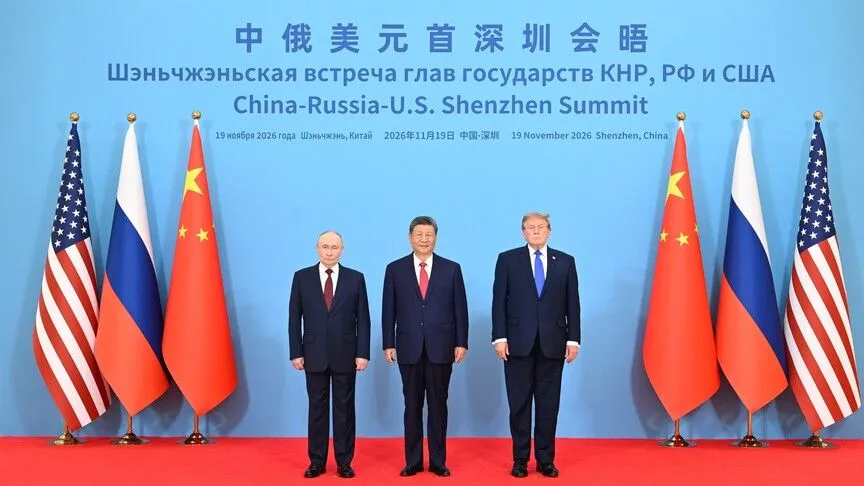
On November 19, Xi Jinping, Donald Trump and Vladimir Putin sat down together at Kylin Villa in Shenzhen, on the sidelines of the APEC summit. It was the first trilateral meeting of the leaders of the world’s three largest nuclear powers. Xi recalled that the three nations had “fought side by side” in the Second World War. Putin described them as its victors, sharing joint responsibility for international peace. Trump told his counterparts they were “really making history”. Commentators reached for Yalta; the better precedent may be 1970s détente, when adversaries agreed not on outcomes but on rules for managing rivalry.
The four-point “Declaration toward Peace” issued after ninety minutes of talks is modest but revealing. As permanent members of the Security Council, the three committed to reforming the United Nations so that it responds more effectively to global challenges. They pledged to raise the supply of refined petroleum products and reaffirmed the importance of stable energy flows. They affirmed state consent and official immunity, warning the International Criminal Court against overreach. And they reaffirmed that “a nuclear war cannot be won and must never be fought”. The three agreed to a dialogue on reducing nuclear risks and preventing proliferation. This is the summit’s most consequential concession. Beijing has long resisted trilateral arms-control talks, citing its smaller arsenal.
The omissions are equally instructive. The text does not mention Ukraine, Iran, Taiwan or the Korean peninsula, although the Chinese statement records that Ukraine, the Middle East and Korea were discussed. It names no mechanism, timetable or follow-up meeting. Even the crisis-communication mechanism that Xi proposed in the room is absent. Xi asked the major powers to respect one another’s sovereignty, avoid crossing each other’s “red lines” and refrain from interfering in internal affairs. That formula describes a concert of great powers more than a rules-based order. Chinese analysts present the framework as a departure from both a Yalta-style division of spheres of influence and unipolar hegemony. The claim will be tested by how the three treat smaller states whose futures they discussed in their absence.
On Ukraine, Shenzhen offered little. Within hours of the meeting, Putin told reporters that after Ukraine’s strikes on the Crimean Bridge, “we will not negotiate”. He ruled out even limited ceasefires on energy infrastructure and Black Sea shipping. He also promised retaliation “far more painful” than the damage to the bridge. The same day, a Coalition of the Willing meeting in Berlin called for precisely those ceasefires and for legally binding security guarantees. Europe feared Ukraine’s future being decided without Kyiv. Trump sought to calm those fears, promising no agreement without Ukraine’s involvement. The distance between Shenzhen and Berlin measures how far a settlement remains.
The Middle East picture is no brighter. Trump said that he and Xi shared an interest in keeping energy flowing through the Strait of Hormuz. They also agreed that Iran cannot have a nuclear weapon. Yet the declaration speaks of supply and stable flows without naming either Iran or the strait. The backdrop is worsening. Exchanges of fire between Washington and Tehran have intensified this month. On November 17, US aircraft hit military targets on Qeshm Island at the mouth of the strait. Iran’s chief negotiator, Mohammad Bagher Ghalibaf, has declared that Hormuz will “never return” to its pre-war status. Neither Beijing nor Moscow publicly undertook to broker an end to the war. Shenzhen therefore rekindles hope for the region only in a limited sense. Any durable Gulf settlement requires the acquiescence of these three powers, and they now treat energy security as a shared concern. The settlement itself, however, is nowhere in sight.
For India, the implications cut both ways. In September 2025, Trump greeted the Tianjin photograph of Narendra Modi, Xi and Putin with the remark that Washington had “lost India and Russia to deepest, darkest China”. Fourteen months later, he sat at a comparable table himself. That vindicates New Delhi’s insistence that engagement with Moscow and Beijing reflects strategic autonomy rather than alignment. A steadier Washington-Moscow channel also eases pressure on India’s energy choices. In October, Trump waived the tariffs of up to 100 per cent that the Graham Sanctioning Russia and Iran Act authorised against buyers of Russian crude. India imported about 1.9 million barrels a day of it in September. A shared commitment to stable energy flows also serves an importer whose Gulf supplies remain hostage to the Iran war.
The risks, however, are structural. A framework in which three permanent members define the terms of UN reform sits uneasily with India’s long-standing claim to a permanent seat. If mutually respected “red lines” mature into tacit spheres of influence, Asia’s middle powers will have less room to manoeuvre. A Washington-Beijing understanding that discounted Indian concerns over the boundary or China’s expanding presence in South Asia would undercut the Quad’s strategic logic.
If the declaration becomes a functioning nuclear dialogue and helps reopen Hormuz, Shenzhen may be remembered as the moment great-power rivalry acquired a grammar of restraint. For India, the task is to ensure that this grammar does not harden into a condominium. New Delhi enjoys working relationships with all three capitals, a standing few other powers can claim. It should use that standing to press for UN reform that widens the permanent membership rather than ratifying the privileges of the existing members. It should insist that any arrangement for Gulf energy security involves the major importers and the littoral states, not only the great powers. Shenzhen should strengthen India’s case that a genuinely multipolar order cannot be managed by three capitals alone.
