
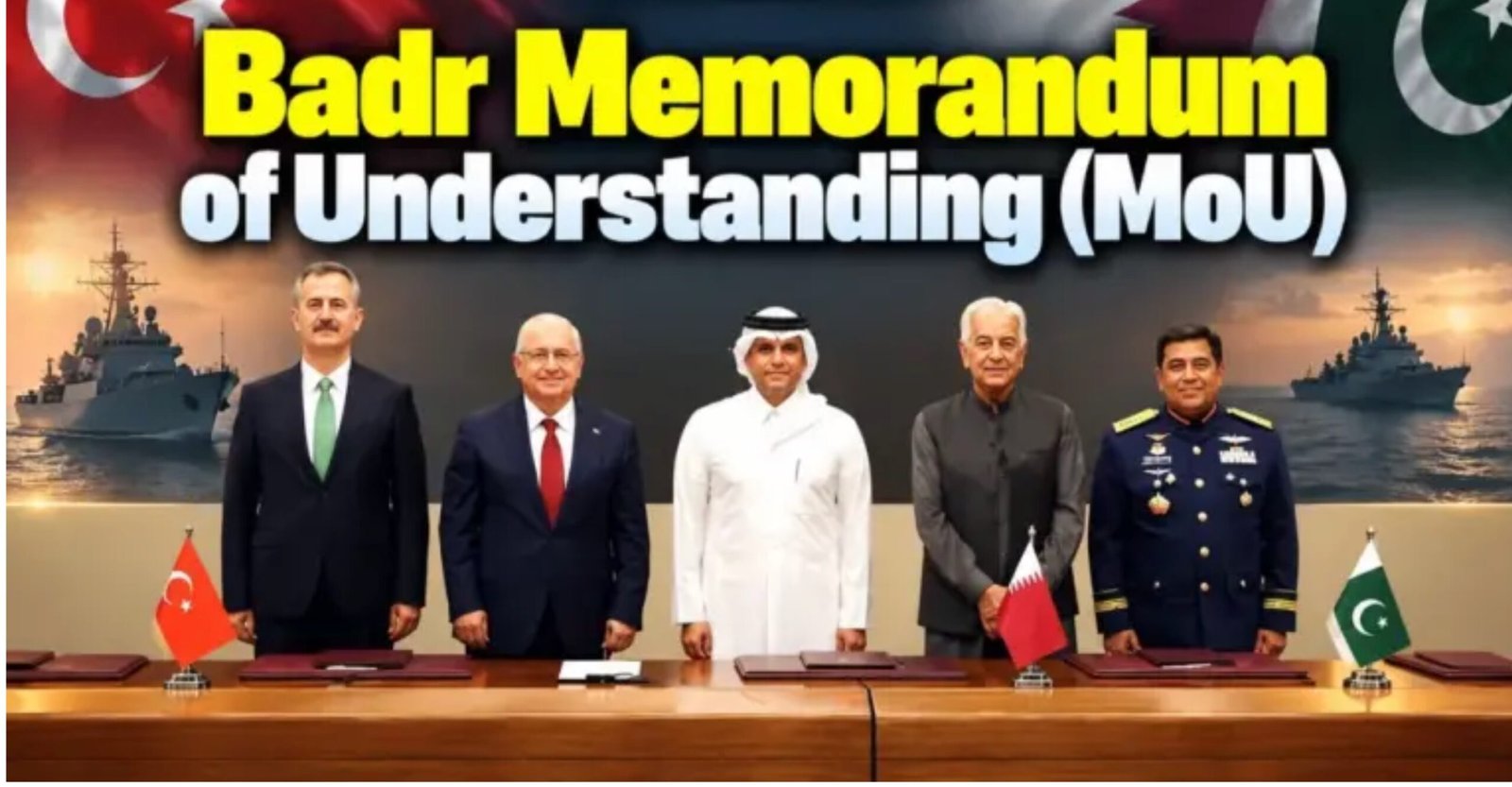
Each member approaches Badr with different expectations, while Pakistan links it to the Makkah security framework and India weighs the longer-term consequences.
The Badr Memorandum of Understanding, signed in Doha on 21 October by Türkiye, Qatar, Pakistan and Indonesia, is best understood as an attempt to coordinate defence production across four very different economies. It is not a pledge to fight each other’s wars. Its declared fields are manufacturing, technology transfer, research and development, technical training and industrial capacity. Reports indicate that an Executive Board will identify projects, and a Strategic Board will approve them and set implementation schedules. No government has yet announced the first weapon, factory, budget or delivery date. That distinction matters because the political symbolism is already running ahead of the machinery.
Badr nevertheless gains strategic weight from its timing. It follows the Makkah Joint Defence Agreement, signed in August by Türkiye, Saudi Arabia and Pakistan. The Makkah pact includes a collective-defence clause, intelligence sharing, logistical support, and provisions for joint training and arms production. Its response to an attack still requires consultation and an assessment of the assistance needed, but it is a treaty-level security commitment. Badr could provide an industrial layer beneath that commitment by producing, repairing or replenishing some of the capabilities on which deterrence depends. The two arrangements differ but could be complementary.
The four Badr members are not entering the arrangement for the same reason. Türkiye is the industrial anchor. Ankara aims to convert separate bilateral successes, including corvettes with Pakistan, armoured vehicles with Qatar and a medium tank with Indonesia, into a broader production network. Larger joint orders would reduce costs, deepen supply chains and give Turkish firms access to partner-country factories and markets. Badr also advances Türkiye’s foreign policy by making its defence technology the connective tissue of a partnership spanning the Gulf, South Asia and Southeast Asia.
Qatar brings a distinct mix of assets and needs. It has capital, demand for advanced equipment, and close defence relations with Türkiye, but a limited domestic manufacturing base. Doha can use Badr to acquire technology, enable local assembly, and secure more reliable access to munitions and maintenance. Recent missile and drone threats have heightened the urgency of affordable air defence and counter-drone capability, although no such project has been formally announced under Badr. Qatar is seeking additional options rather than abandoning its extensive security relationship with the United States.
Indonesia, meanwhile, views Badr through the lens of industrial development. Jakarta has emphasised research, technology transfer, investment, human resources and participation in international supply chains. Indonesia’s existing tank programme with Türkiye offers a model for domestic production. Indonesia’s involvement also gives Badr geographic breadth and access to a large market. Yet President Prabowo Subianto’s insistence that Indonesia remains non-aligned places an important limit on the arrangement: Jakarta regards Badr as an industrial partnership, not an anti-Western or anti-India military bloc.
Pakistan stands to gain from all three partners. Diplomatically, it becomes the link between the Saudi-centred Makkah pact and the Qatar-centred Badr framework, improving its access to decision-makers across the Gulf and Southeast Asia. Appointing a retired Pakistani general as the first secretary-general of the Makkah arrangement further raises Islamabad’s profile. Militarily, Badr could combine Turkish design and systems integration, Qatari finance and Indonesian scale with Pakistan’s manufacturing capacity. The MILGEM programme, under which Pakistan built two corvettes at Karachi Shipyard, shows how Pakistan can secure infrastructure and skills, not just finished equipment. Common production could generate maintenance work, exports and alternatives to excessive dependence on Chinese systems. These gains remain conditional on actual orders, agreed workshare and meaningful technology transfer.
Badr can therefore work in tandem with the Makkah pact, but the link will be functional rather than automatic. The Makkah pact may create demand for air defence, electronic warfare, ammunition and logistical support; Badr could eventually help meet part of that demand. Pakistan and Türkiye provide the bridge. However, an institutional merger is unlikely. Saudi Arabia is not a Badr member, while Qatar and Indonesia have accepted no collective-defence obligation. Procurement interests, export controls and political rivalries will determine whether projects move between the two frameworks.
Taken together, the agreements signal a stronger regional preference for self-reliance. The Iran war, Houthi attacks and doubts about the speed or conditions of Western support have exposed the risks of relying on a single external security provider. Gulf states increasingly seek local production, diversified suppliers and the capacity to maintain weapons during a crisis. This is hedging, not a wholesale rejection of the United States. Qatar still hosts major US forces, Türkiye remains in NATO and Gulf militaries will retain large Western inventories. Saudi Arabia’s absence from Badr reflects its priorities under the Makkah Agreement and its focus on its localisation programme; the UAE, with its own capable industry, continues to favour flexible partnerships and strategic autonomy.
For India, Badr poses no immediate military threat. It contains no known collective-defence commitment, while Qatar and Indonesia have compelling reasons to preserve stable relations with New Delhi. Nevertheless, India should ensure that its BrahMos contract and air-to-air missile cooperation with Indonesia are protected by stringent end-use, data-security and intellectual-property safeguards. There is no public evidence that India has transferred core missile-design technology to Indonesia, let alone that Jakarta’s participation in Badr would give Pakistan access to Indian systems. The prudent concern is the possible exposure of operational data, maintenance documentation or system characteristics—not any demonstrated leakage of technology. The more consequential question is whether Badr could progressively enhance Pakistan’s access to Turkish drones, sensors, electronic-warfare systems, air-defence capabilities and reliable supplies of spares and munitions. India should therefore closely monitor the projects selected under Badr, including their production locations, corporate participants and technical personnel, while requiring clear technological firewalls in its defence cooperation with Indonesia.
The commercial challenge is equally important. India exported a record Rs 38,424 crore of defence equipment in 2025-26 and views the Gulf as a promising market. Badr could offer buyers a package of Turkish technology, Qatari finance and local assembly, enabling competition in drones, ammunition, patrol craft and counter-drone systems. However, Badr’s reach is limited by the absence of Saudi Arabia and the UAE, the Gulf’s two largest defence-industrial markets. New Delhi should respond by improving credit, delivery and after-sales support, while pursuing co-production with Gulf partners. Badr deserves close attention because it may strengthen Pakistan and intensify industrial competition. It does not yet justify treating four countries with divergent interests as a unified anti-India alliance.
