
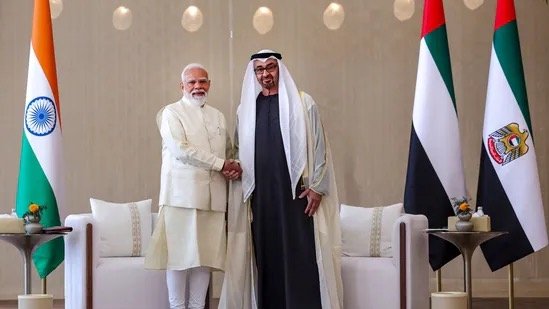
When Prime Minister Narendra Modi landed in Abu Dhabi on the morning of May 15, he was received by a formation of UAE military jets — a ceremonial gesture that carried more analytical weight than protocol alone could explain. The escort was not simply a welcome. It was a statement of alignment, offered at a moment when the Gulf’s strategic geography is being forcibly redrawn by war, and when the Indian Ocean’s most consequential chokepoint has been effectively weaponised.
The visit was brief. But its outputs — a formal Strategic Defence Partnership framework, twin energy agreements on LPG and strategic petroleum reserves, a maritime MoU for a ship repair cluster at Vadinar, and $5 billion in investment commitments — constitute a substantive upgrading of one of India’s most structurally important bilateral relationships. Those who see in this stopover little more than a scheduled courtesy call between friendly heads of state will find the depth of its outcomes instructive.
The Hormuz Statement as Policy Signal
The most consequential moment of Modi’s Abu Dhabi engagement was neither a signed document nor an investment figure. It was what he said in the delegation room. “It is our biggest priority that Hormuz remains free and open,” Modi declared. “In this regard, it is essential to abide by international laws.” The framing is careful: India does not name Iran, does not invoke military options, and does not commit to enforcement. But the political direction is unmistakable. In the current West Asian context — where Iran’s closure of the strait has directly wounded Indian supply chains, strained the rupee, and raised domestic fuel costs — Modi’s Hormuz statement is the most direct public signal New Delhi has sent about the limits of its multi-vector balancing.
The timing is deliberate. The previous day in New Delhi, Iranian Foreign Minister Araghchi was attending the BRICS foreign ministers’ summit. India hosted him. India’s Prime Minister then flew to Abu Dhabi and stood in solidarity with a nation that has accused Iran of attacking its oil infrastructure. This simultaneity — rather than being contradictory — is precisely the architecture of India’s strategic autonomy. New Delhi maintains functional diplomatic channels with Tehran while signalling, at the leader level, that the weaponisation of Hormuz is an existential concern that cannot be accommodated within normal multi-alignment calculus.
Energy Lockdown and the Vadinar Signal
The LPG agreement and the Strategic Petroleum Reserve MoU are not ceremonial instruments. The UAE supplies nearly 40 per cent of India’s LPG requirement — a share that has been under acute pressure since the closure of the Strait of Hormuz began disrupting Gulf tanker traffic. The SPR MoU builds on an arrangement dating back to 2018, when ADNOC agreed to store crude at India’s Mangaluru facility. Together, these agreements are attempts to institutionalise energy supply continuity against the backdrop of a disruption environment that has moved from theoretical to operational.
The Vadinar Ship Repair Cluster MoU deserves particular attention. Vadinar, on India’s western coast in Gujarat, is not incidental geography. It is India’s largest single-point mooring terminal and the natural terminus of any rerouted Gulf supply flow that bypasses the strait through the Port of Fujairah on the Omani Sea. The existing Habshan-Fujairah pipeline in the UAE already provides partial bypass capacity for Abu Dhabi’s crude. What today’s agreement begins to build — on the Indian end — is the complementary maritime infrastructure to receive and service vessels operating in that corridor. As Hormuz remains contested, Abu Dhabi and New Delhi are jointly constructing an operational alternative, one agreement at a time.
The Defence Architecture Comes of Age
The conversion of January’s Letter of Intent into a formal Strategic Defence Partnership framework is the most enduring strategic output of the visit. India and the UAE have been building practical cooperation through naval exercises, counter-terrorism coordination, and defence industrial consultations for several years. The active conflict environment in the Gulf — including the Iranian attack on Fujairah’s oil infrastructure on May 4 that wounded three Indian nationals — brought into sharp focus what both leaderships already understood: that the bilateral relationship had outgrown the instruments designed to govern it. The Framework Agreement elevates bilateral ties from transactional procurements to structured industrial and operational collaboration. It fosters joint capability development and interoperability, aligning with India’s broader objectives in the Indian Ocean Region and the Indo-Pacific.
The $5 Billion Investment push in Infrastructure
The investment announcement — $5 billion directed toward Indian infrastructure, RBL Bank, and Samman Capital — reflects the UAE’s enduring confidence in India’s growth story even amid global turbulence. Cumulative UAE foreign direct investment in India now exceeds $22 billion, affirming the Gulf partner’s position as a reliable and deepening source of capital. More analytically significant is the composition of the latest commitment: the channelling of capital into a mid-tier private bank and a domestic asset management platform signals that UAE institutional money is now penetrating India’s financial sector at structural depth, not merely parking in flagship government-backed infrastructure funds. As the UAE continues its post-hydrocarbon diversification and India expands its capital markets, the financial architecture of this partnership is becoming as important as the energy one.
People, Diaspora, and the Human Dimension
No account of this visit is complete without acknowledging the over 4 million Indians who live and work across the Emirates — the single largest expatriate community in the UAE, and one whose welfare, livelihoods, and remittances have been directly affected by regional instability. Modi’s visit carried an implicit assurance to this community: that India’s relationship with the UAE is robust enough, and its political engagement high enough, to safeguard Indian interests when the region comes under stress. The bilateral relationship, at its most human level, is the daily reality of millions of Indian families whose economic lives depend on the stability that this partnership helps sustain.
India’s Calculus, Redrawn
The Abu Dhabi stopover anchors the energy and security dimensions of India’s Gulf engagement at a moment of acute regional flux. The subsequent European leg of Modi’s five-nation tour will focus on green technology, semiconductors, and trade — but it rests on a foundation that this Gulf visit has just reinforced. The visit demonstrates continuity in New Delhi’s foreign policy doctrine: deepening economic and defence ties with key Gulf partners while preserving strategic autonomy. The partnership’s maturity is visible in its expansion well beyond hydrocarbons — into technology, renewables, artificial intelligence, and financial services.
By prioritising pragmatic outcomes over ideological alignments, India has, in a single morning in Abu Dhabi, strengthened its supply-chain resilience, deepened its geopolitical influence in West Asia, and demonstrated the institutional capacity to navigate an era of heightened great-power competition and regional turbulence with confidence and purpose. The India-UAE Comprehensive Strategic Partnership has not merely survived the pressures of a contested Gulf. It has been forged stronger by them.
