
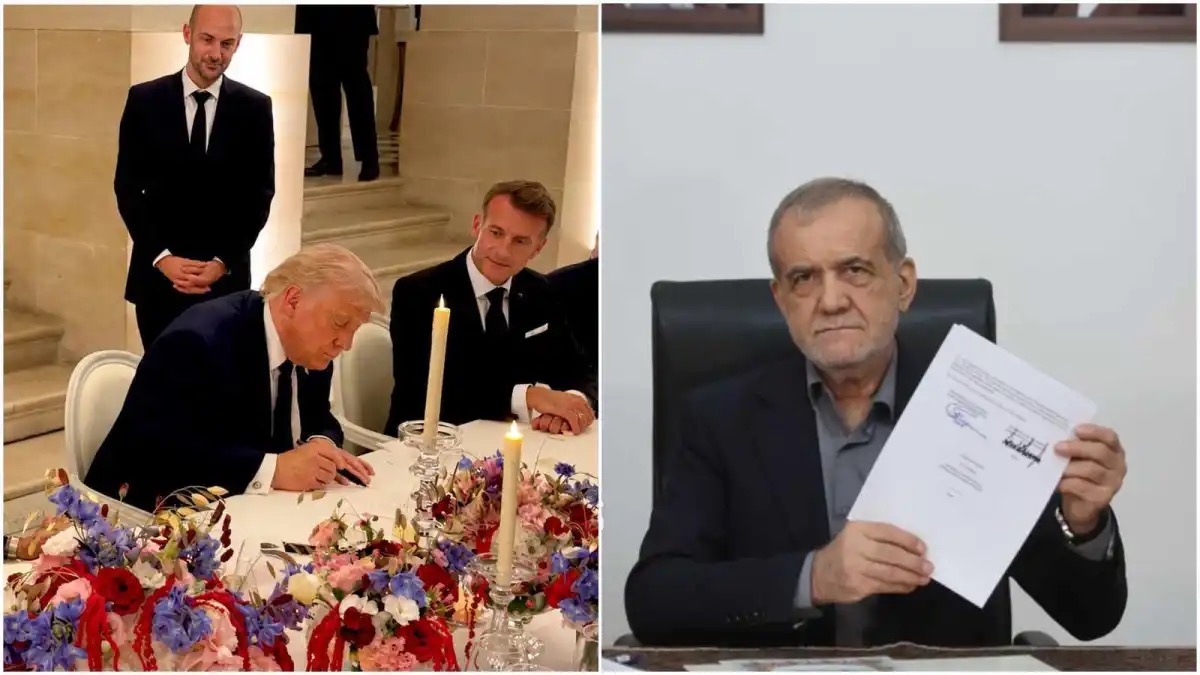
The Islamabad Memorandum has stopped a war and reopened the Strait of Hormuz — a real achievement. Much remains to be negotiated, but for India, the opening it creates is genuine: a chance to secure energy, revive Chabahar, and shape the order ahead.
When US President Donald Trump paused before putting pen to paper at the Palace of Versailles on Wednesday night — “This was not easy,” he told the room — he was signing not a peace, but a permission slip. The 14-point Islamabad Memorandum of Understanding, signed by Trump and Iranian President Masoud Pezeshkian and witnessed by Pakistani Prime Minister Shehbaz Sharif as mediator, has done one major and unambiguous thing: it has ended 108 days of war and begun reopening the Strait of Hormuz. By Thursday, tankers were moving again, and Brent crude had slipped below $79 a barrel — down nearly 40 per cent from its wartime peak above $118 and within touching distance of the roughly $70 that prevailed before the first missiles flew. For a global economy that has spent four months absorbing the largest oil-supply disruption in history, that is no small mercy.
But strip away the relief, and the document reveals itself for what it is: a ceasefire architecture dressed as a settlement. Its most consequential questions — the fate of Iran’s enriched-uranium stockpile, the schedule of sanctions relief, the $300 billion reconstruction fund, and the future administration of Hormuz itself — are all deferred to a 60-day negotiation that begins, fittingly, on neutral Swiss ground. The MoU does not require Iran to surrender its highly enriched uranium; it commits both sides only to a “minimum methodology” of down-blending on site under IAEA supervision. It says nothing about Iran’s ballistic missiles — a silence Trump himself widened on Wednesday when he mused that it was “a little bit unfair” to deny Tehran missiles that Saudi Arabia and Qatar already possess. And it leaves Iran’s network of regional proxies entirely off the agenda.
This is why the balance sheet reads so awkwardly for the war’s architects. The United States and Israel launched Operation Epic Fury in February with three declared aims: ending Iran’s nuclear programme, curbing its missiles, and — in the hopes of some — toppling its regime. None has been achieved. Tehran’s theocracy is intact under a new Supreme Leader, its missile arsenal untouched, its nuclear knowledge irreversible. In exchange for a reaffirmed pledge it has always made — that it will not build a bomb — Iran secures immediate oil-export waivers, the unfreezing of up to $24 billion in assets, and a reconstruction commitment its negotiators can plausibly call a victory. Saudi analyst Abdulaziz Sager put it bluntly to Reuters: Washington “switched from unconditional surrender to an MOU. They caved in.”
Israel, excluded from the talks it helped precipitate, is the clearest loser. Prime Minister Benjamin Netanyahu, facing autumn elections and open revolt within his coalition, insists he is unbound by the deal’s Lebanon ceasefire and that the IDF will remain in the south. That defiance is the single greatest threat to the agreement’s survival: one Hezbollah rocket, one Israeli strike, and the carefully sequenced edifice could collapse. The contradictions are already visible in the enforcement mechanism — of which there is essentially none. Asked what binds Iran, Trump replied that nothing needs to: “We’re gonna bomb the hell out of them if they violate the agreement.” A deterrent that rests on the temperament of one leader, who concedes he cannot speak for his successors, is a fragile foundation for regional order.
For the great powers, the war has quietly rearranged the board. China, Iran’s largest oil buyer, has emerged with its energy lifeline preserved and its self-image as a stabilising broker burnished — Trump even thanked Xi Jinping and Vladimir Putin for their help. The Gulf monarchies, having discovered that neither the Abraham Accords nor American bases spared them Iranian missiles, are hedging hard: Abu Dhabi is racing to double its Hormuz-bypassing Fujairah pipeline, and the UAE and Saudi Arabia are diversifying defence ties toward Europe and Asia. The lesson they have drawn is structural and permanent, and no memorandum will reverse it.
India sits at the favourable end of this ledger, but should resist triumphalism. The immediate gains are real: a falling oil import bill, easing inflationary pressure, relief for a rupee battered by the energy shock, and the prospect of resumed Iranian crude and LPG flows that transit through the Strait of Hormuz. New Delhi still has 13 Indian-flagged vessels and 325 seafarers awaiting safe passage west of the Strait; their release is a humanitarian dividend of the deal. The broader sanctions normalisation envisaged in the MoU could also lift the cloud over the Chabahar port — where India has sunk $120 million and considerable strategic capital — after the US waiver lapsed in April, and could breathe life back into the International North-South Transport Corridor.
Yet each of these prizes is contingent, not delivered. Energy analysts are unanimous that Hormuz normalisation will take “weeks, if not months” — demining, insurance, tanker repositioning, and the restart of shuttered wells cannot be conjured by signature. Chabahar’s revival depends on a durable lifting of secondary sanctions that the MoU only gestures toward. And the deepening of China’s footprint in West Asia, alongside Pakistan’s elevation as the indispensable mediator, complicates the strategic terrain India must navigate. The “Hormuz exception,” which briefly eased passage for some Indian cargoes during the war, was always a temporary courtesy, not a bilateral guarantee; New Delhi should not mistake this moment for a new permanence.
For India, the prudent posture is the one it has held throughout: engage all sides, bank the energy relief, and accelerate quietly on Chabahar and the connectivity corridors the calmer waters now reopen. The harder work — turning a ceasefire into a settlement — still lies ahead, in Switzerland, in southern Lebanon, and in Tehran. But for the first time in four months, the region has been handed something it can build on: open sea lanes, falling prices, and a negotiating table where there was only a battlefield. Diplomacy has bought the time that force could not. Used wisely, a pause of this kind can become the foundation of a durable peace — and India, with its steady friendships across every fault line of West Asia, is well placed to help it hold.
