
Photo Credit: AFP/BBC
Saudi Arabia’s first direct intervention in the Iran war signals the erosion of American protection and the emergence of a more transactional Gulf order.
For five months, Saudi Arabia absorbed the impact of the war with Iran rather than entering it directly. Missiles struck Al-Kharj and Prince Sultan Air Base; drones targeted Ras Tanura and Shaybah. Each time, the kingdom intercepted the attacks, issued condemnations, and held its fire. That restraint ended in the early hours of 29 July, when Saudi jets flew alongside American aircraft to strike Iran-aligned militias in eastern Iraq.
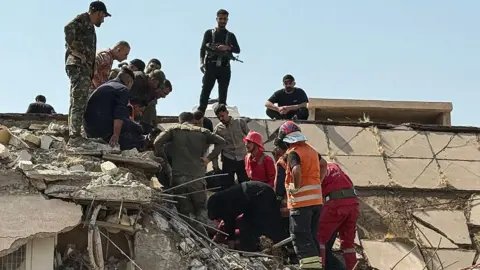
Riyadh’s Defence Ministry described the operation as a series of precision strikes against groups linked to attacks on Saudi oil facilities. It invoked Article 51 of the UN Charter while insisting that the kingdom did not seek further escalation. US Central Command, which had recorded more than thirty Iranian-directed drone attacks over the preceding seventy-two hours, confirmed the operation was conducted jointly. Iraq’s Popular Mobilisation Forces reported twenty dead and thirty-two wounded, while the Islamic Resistance in Iraq dismissed the Saudi account as a fabrication. Within hours, Iran launched a salvo against American forces that Central Command intercepted, followed by another volley directed at a US base in Jordan. President Donald Trump responded by promising Tehran “a beating”. The pause was over.
It is tempting to interpret the episode as merely another turn of the military ratchet. It is better understood as the moment when the arrangements that had governed Gulf security since the 1970s became untenable.
Riyadh acted when it did not because Iranian attacks were new, but because the two conditions that had made continued restraint affordable collapsed almost simultaneously.
The first was confidence in American protection. General Dan Caine, chairman of the Joint Chiefs of Staff, privately warned President Trump that dwindling interceptor stocks could constrain the defence of US forces and regional allies if the fighting intensified. Admiral Brad Cooper, meanwhile, reported that the Hormuz campaign had exhausted most of its targets. Both assessments helped shape the pause announced on 24 July—a pause that owed less to an Iranian concession than to the limits of American inventories.
The second condition was the viability of Saudi Arabia’s principal energy bypass. Throughout the war, the kingdom had diverted crude away from the Strait of Hormuz through the East-West pipeline to Yanbu, increasing its throughput roughly fivefold. On 25 July, however, the Houthis struck Aramco’s Jazan refinery. Two days later, drones hit Abqaiq, the world’s largest crude-oil stabilisation plant, as well as the station feeding the East-West pipeline. The workaround had itself become a target. Once that happened, waiting no longer paid.
What Iran has gained from five months of war is not territory but something closer to a toll booth. Before February, roughly one-fifth of the world’s oil and gas passed through the Strait of Hormuz. Tehran has since closed it, reopened it and closed it again, with crude prices following each move: above $100 last week, down into the low eighties as negotiations resumed, and then up five per cent after Tuesday’s salvo.
Oman’s mediation proposal would, in effect, formalise some of that leverage. Muscat has suggested a joint mechanism modelled on the Straits of Malacca, where users make voluntary contributions towards navigation and safety. Its plan envisages three lanes—one Iranian, one international and one Omani—without placing the Strait under exclusive Iranian control.
Tehran has rejected the proposal, demanding a share of the Omani lane in addition to control over its own. Mohammad Bagher Ghalibaf, the speaker of Iran’s parliament, has declared that administration of the Strait will never revert to its pre-war form. On the surface, the disagreement appears to be about money: the Malacca mechanism raises perhaps $70 million annually, whereas Iran has proposed a charge of $1 million per ship. In reality, however, the dispute is about jurisdiction. International law prohibits tolls on transit through natural straits but permits charges for services rendered. A coastal state that is formally paid for providing such services acquires an institutional standing it did not previously possess.
That precedent may already be in motion. Reports indicate that the Houthis, a week after blockading Saudi ports, are considering fees for vessels passing through Bab el-Mandeb, which carries approximately seven per cent of the world’s energy supply. The proposal was reportedly discussed with Iranian officials in Tehran this month. Iranian advisers are said to be helping establish an authority to collect the charges, while Chinese vessels would be exempt under a separate understanding with Beijing. Regional officials suspect the purpose is to normalise charging ships for passage through international waterways. Two chokepoints, one method—and one great power may already have purchased an exemption.
While Iran seeks to monetise geography, Saudi Arabia is pursuing a different form of compensation. On 22 July, US Energy Secretary Chris Wright and Prince Abdulaziz bin Salman signed a thirty-year civil nuclear agreement under Section 123 of the US Atomic Energy Act. Rather than resolving the central question of uranium enrichment, the agreement defers it. It provides for a two-year study of the commercial viability of enrichment and, should the findings be favourable, an American-built facility that Saudi Arabia would operate but not own.
That ambiguity lasted less than a day. On 23 July, President Trump announced on social media that Saudi Arabia would not be permitted to enrich uranium and that the agreement depended on normalisation with Israel. Neither condition appears in the signed text, which remains unpublished. Normalisation, moreover, remains something Riyadh continues to link to a credible path towards Palestinian statehood.
Washington has therefore spent five months bombing Iran in order to deny it a complete nuclear fuel cycle while signing an agreement that leaves open the possibility of granting one to Iran’s principal regional rival. The safeguards only deepen the inconsistency. Saudi Arabia has never accepted the renunciation of enrichment and reprocessing adopted by the United Arab Emirates in 2009. Nor has it brought the International Atomic Energy Agency’s Additional Protocol into force, and the new agreement does not oblige it to do so. Abu Dhabi may now seek to reopen the terms of its own nuclear arrangement, while Cairo and Ankara will inevitably draw conclusions of their own.
These developments are not separate stories. Together, they reveal an emerging regional order with three defining characteristics.
First, passage through international waterways is becoming a commodity—sold by those capable of credibly threatening it and discounted for states that prove strategically useful. Second, security is increasingly being self-underwritten. That is why Riyadh is now flying its own combat missions, maintaining a mutual-defence pact with nuclear-armed Pakistan, keeping diplomatic channels open to Tehran and securing a deferred route towards uranium enrichment. Third, alignment is becoming transactional rather than architectural: Oman mediates, Qatar threatens to step back, the Emirates operate quietly, and Iraq functions less as a sovereign arbiter than as a battlefield for competing powers.
US Central Command has prepared an option for a fortnight of intensive strikes, and President Trump is reportedly considering it. Whatever such a campaign might achieve militarily, it will not restore the regional order that existed before February. That order is not merely being suspended. It is being replaced.
